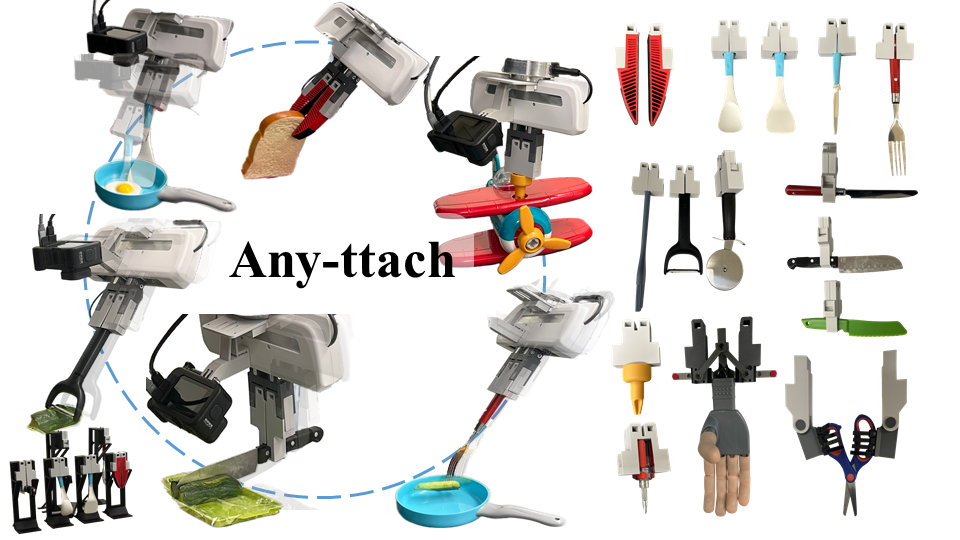
Robotic manipulation dexterity is often pursued by building increasingly complex high-DoF multifingered hands. While many robotic hands are designed to replicate the morphology of human hands, the functional role of human hands suggests a different perspective: much of their complexity may exist to enable tool use and tool making. This observation motivates Any-ttach: a tool-centric manipulation framework that leverages mechanical modularity and treats end-effector swapping as a primary mechanism for dexterity. Any-ttach combines three components: 1) a low-cost, automatic, and easily deployable swapping mechanism for a 1-DoF parallel gripper, 2) a handheld device for collecting human demonstrations, and 3) a task planning framework that composes learned, parameterized, and planned skills for flexible use of diverse tools. The system supports everyday tools, articulated tools such as scissors, and a low-cost anthropomorphic hand through the same end-effector interface. Our experiments show that Any-ttach improves tool-swapping reliability, enables more efficient demonstration collection, reduces tool-pose variability, and supports diverse tools and end-effector modules. In two long-horizon tasks, making a sandwich and preparing a cucumber, Any-ttach executes 6 tool use subskills and demonstrates that hierarchical tool-skill decomposition can improve complex task reliability.
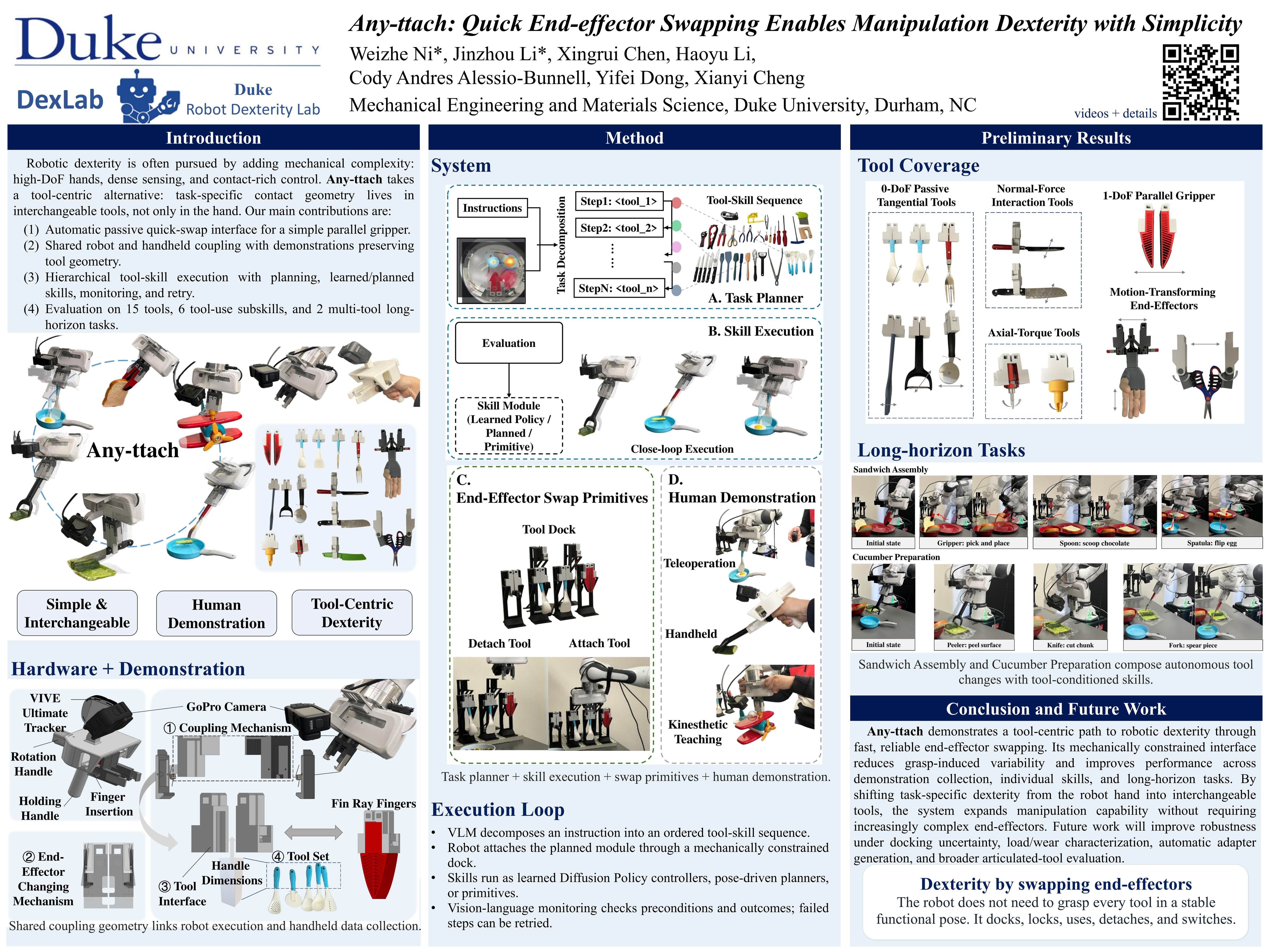
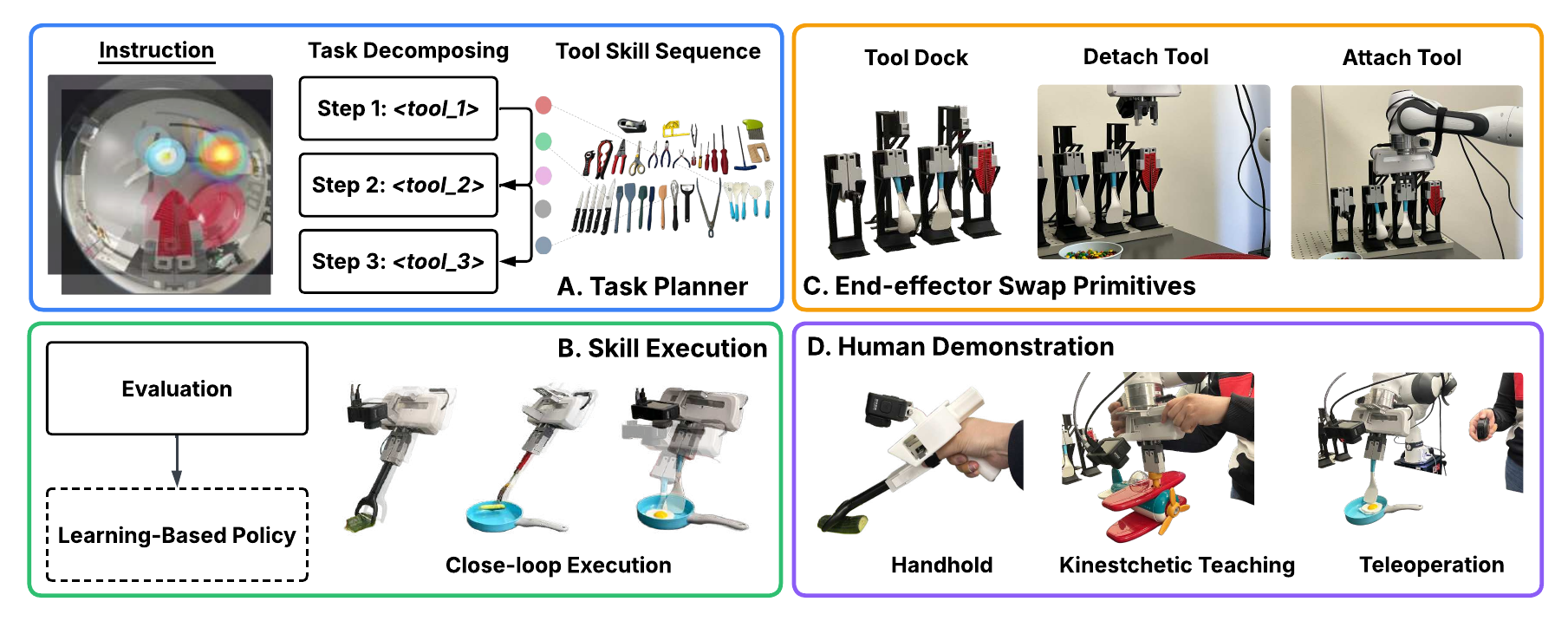
Any-ttach is structured as a three-stage pipeline: (1) a task planner maps language instructions to an ordered sequence of tool-skill pairs, (2) each skill is executed in closed loop using learned or planning-based modules, and (3) verifiers check tool attachment and task completion to enable automatic retry.
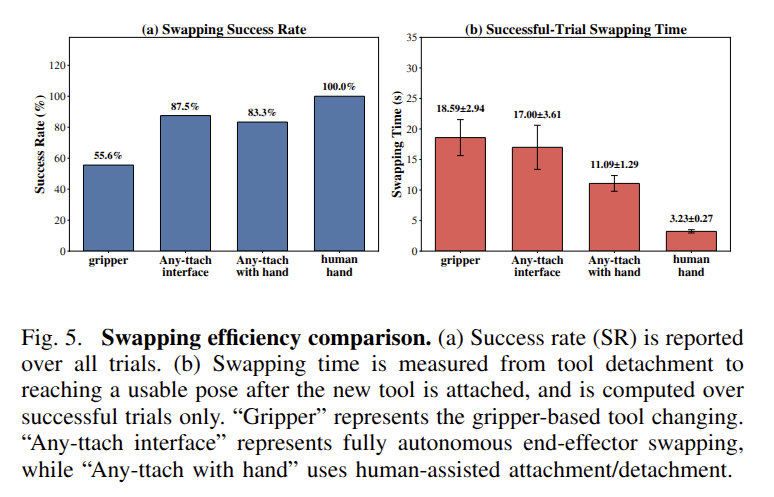
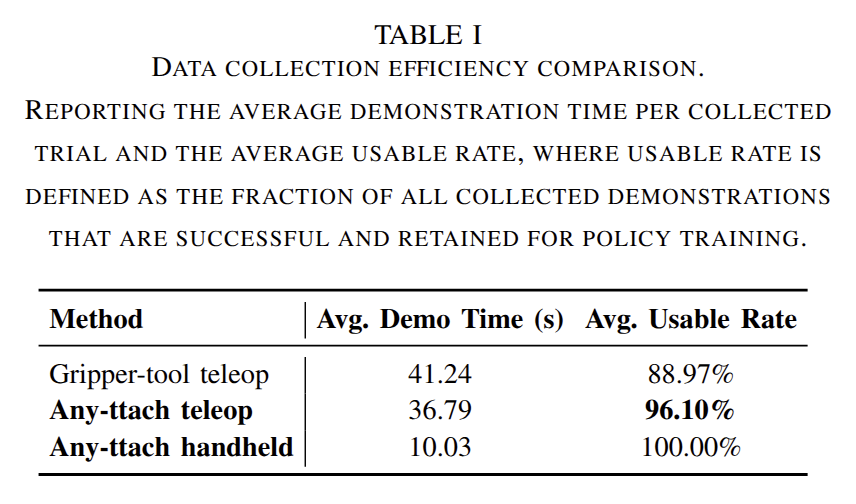
We evaluate the proposed end-effector swapping mechanism from two perspectives: autonomous swapping performance and demonstration efficiency. The results show that the Any-ttach interface improves swapping reliability and supports more efficient collection of usable demonstrations for tool-centric manipulation.
We evaluate Any-ttach on two representative long-horizon tasks:
@article{ni2026anyttach,
  title   = {Any-ttach: Quick End-effector Swapping Enables Manipulation Dexterity with Simplicity},
  author  = {Ni, Weizhe and Li, Jinzhou and Li, Haoyu and Pan, Wenjing and Alessio-Bunnell, Cody Andres and Cheng, Xianyi},
  journal = {arXiv preprint arXiv:2605.30569},
  year    = {2026}
}